
What you will find here
Poor scope definition is a leading cause of project failure. Understand why it happens and how to define scope so your project does not fail.
Two layers are worth separating. The traditional structure of the topic is scope management, made of identifying stakeholders, collecting requirements, defining scope, creating the WBS and controlling changes. The complementary instruments are artifacts such as the WBS and the schedule, which organize and track that scope without defining it on their own.
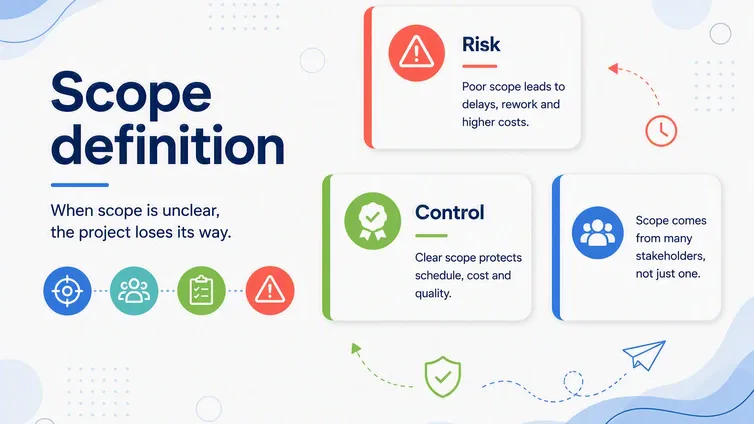
Many projects start with energy, meetings, a schedule and a mobilized team, yet they end in delays, changes and rework. One cause stands out among the most frequent: poor scope definition. When scope is unclear, schedule, cost and quality follow the same path.
Scope describes what the project will deliver and, above all, what it will not. It does not come from a single person. It is derived from several stakeholders, internal and external, each with a need, a requirement or a constraint that must be considered in planning.
Good scope definition does not rely on luck, but on method. Identifying stakeholders, understanding the problem and recording deliverables and exclusions turns a vague request into a clear plan, able to sustain schedule, cost and quality across the project.
01Setting the boundaries: the concept and its instruments
In this article you will find out why poor scope definition makes projects fail, how stakeholders and requirements shape scope, the difference between explicit and implicit scope, the role of the WBS and how scope influences schedule, cost, quality and risk.
The table below summarizes scope management in stages, showing the goal of each one and how to apply it in practice.
| Stage | Goal | Practical application |
|---|---|---|
| Identify stakeholders | Map who influences and is impacted by the project | List internal and external participants before defining the deliverables |
| Collect requirements | Understand the problem before designing the solution | Document needs that guide the project deliverables |
| Define scope and exclusions | Set what is in and what is out | Record deliverables and exclusions that avoid unplanned work |
| Create the WBS | Break scope into deliverables and work packages | Organize deliverables by categories and subprojects |
| Plan schedule and cost | Derive activities, resources and budget from scope | Tie each schedule activity to a scope deliverable |
| Control scope | Track changes and planned versus actual | Compare planned deliverables with the delivered work across the project |
Would rather follow the topic visually? Watch the conversation about scope definition applied to project management.
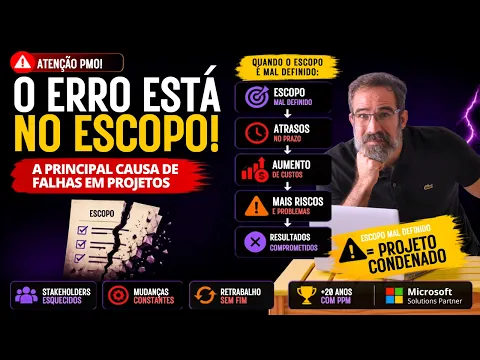 Play video: Scope definition applied to project management
01. Why poor scope definition makes projects fail
Failure rarely shows up at the start. It appears as the project moves forward and someone realizes a need was not considered. In most cases this happens because scope was not fully defined, not because the team lacked effort.
A set of signs tends to precede this problem. They help you recognize early that scope definition became fragile:
- Important stakeholders were not identified at the start of the project.
- The schedule was built before requirements were understood.
- The client could not clearly explain what was needed.
- Part of the scope stayed implicit, with no explicit record.
When one of these points goes unnoticed, the effect appears later. Changes enter mid execution; the schedule stretches and cost rises. The project can be seen as a failure for not delivering on time and on budget.
02. Scope, the backbone of planning
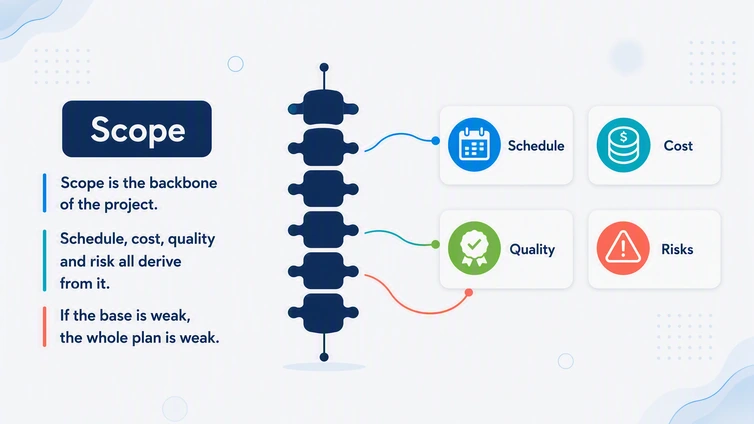
Scope works as the backbone of the project. Schedule, cost, procurement, risks and quality all derive from it. If the base is fragile, everything that rests on it becomes fragile too.
Defining scope is, in practice, predicting the work that will run in the future to solve the client problem. Planning organizes that work, and management techniques help predict better and structure each stage.
For this reason, incomplete scope is not a detail. It compromises the schedule, the resource estimate, the quality checks and the communication with those who take part in the project.
03. Stakeholders, the real source of scope
There is a common perception that scope is defined only by the client who requested the project. In practice, it derives from several stakeholders, internal and external, who are not always visible at the first contact.
Each stakeholder describes the project differently. One brings more depth, another brings a date constraint, another asks for something outside the scope. Identifying them all avoids having them appear mid project with a new need.
Think of the renovation of a large store in a mall. Saying only renovation explains nothing. Board, store manager, sales, HR, logistics, IT, legal, finance and the mall management all influence the result, each with its own requirement.
04. Requirements gathering, from problem to solution
The client is not expected to define scope. It is up to the team to use requirements gathering techniques to help explain what the client needs and which problem they want to solve.
An effective path starts with the problem, not the solution. First, you understand the pain, the need or the opportunity. Then you design the solution, which is the scope. That way the deliverable stays tied to the project rationale.
A business view completes this work. Showing how scope helps drive results makes executives more receptive and connects the project to what the company really expects.
05. Explicit scope and the danger of implicit scope
Every well defined scope separates what is in from what is out. Exclusions prevent the client from expecting something that was never agreed. Without them, expectation stays open to interpretation.
Implicit scope is a frequent trap. The client believes something was included, even though it was not clear to either side. If it is not explicitly recorded, it is hard to consider in planning.
Recording deliverables and exclusions from the start reduces changes, protects schedule and cost and gives an objective reference when a request arrives outside the agreement.
06. Traditional and agile approach, scope in each model
Scope appears in both models, but in different ways. In the traditional approach it is defined in detail at the start. In agile it is defined at a high level and evolves during execution, with adaptations along the way.
Each type of project calls for a model. Engineering projects, such as building a bridge, tend toward the traditional. Continuous improvement and support fit agile well, since it accepts change naturally.
Agile flexibility has a trade off. A scope change mid project affects schedule and cost. When the client does not accept changing schedule and cost, scope needs to be well defined from the beginning.
07. The WBS, deliverables before activities
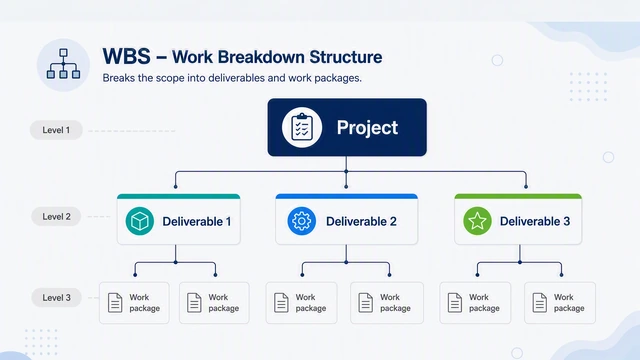
The work breakdown structure, or WBS, is a visual element that helps define the project deliverables. It breaks scope into work packages and organizes understanding by categories and subprojects.
The WBS prompts the client to remember what they need. Being visual, it shows the deliverables in an organized way and helps complete the scope, something a single question rarely achieves.
It is a hierarchy of deliverables, organized by categories and subprojects. It is worth separating deliverables from activities: the WBS defines what will be delivered, while the schedule handles when and by whom the work is done.
08. From scope to schedule, cost and control
With scope defined, activities exist to produce the deliverables. The schedule organizes those activities on a timeline, with duration, owners and sequence of execution.
Activities connect through dependencies, the linkage that sets the order of work. A task often begins only when the previous one finishes, and this logic holds the whole schedule together.
Recording the approved plan, with dates, durations and costs, allows you to compare planned with actual across execution. This comparison helps spot schedule and budget deviations early.
This chain shows why scope is central. Incomplete scope generates incomplete activities, imprecise resource estimates and a plan that does not represent the real project.
09. Strategic decision, when to reinforce scope definition
Not every project needs the same level of formality, but all benefit from clear scope. Some scenarios call for extra attention before committing to schedule and cost:
- The client cannot clearly explain the problem to solve.
- The project involves many internal and external stakeholders.
- There is pressure to start before scope is defined.
- The schedule depends on access, licenses or initial integrations.
- The contract is fixed, with little room for scope change.
In these cases, it is worth asking for as many meetings as needed to understand scope, recording deliverables and exclusions and aligning the schedule with those involved. Initial setup time, such as access and integrations, also counts toward the schedule.
10. Frequently asked questions
What is scope definition in a project?
Scope definition describes the project deliverables and sets what is in and what is out. It derives from several stakeholders and serves as the basis for schedule, cost, quality and risk.
Why do so many projects fail because of scope?
Because stakeholders are not fully identified, the schedule is built before requirements or part of the scope stays implicit. This creates changes mid project, with impact on schedule and cost.
What is the difference between scope and activities?
Scope defines what will be delivered, represented in the WBS. Activities define when and by whom the work will be done, represented in the schedule. Mixing the two is a common mistake.
How do I start defining scope well?
Start with the problem, not the solution. Identify stakeholders, understand the pain or need, and only then describe the deliverables and exclusions that respond to it.
Does a well defined scope eliminate changes?
No. It reduces changes and gives an objective reference when a new request appears, which makes it easier to assess the impact on schedule and cost before deciding.
12Continue your journey
To go deeper, explore other MLPro blog content on project management and the good practices involved in this routine. The MLPro YouTube channel gathers conversations and practical demonstrations applied to the daily work of project teams.
13About MLPro
MLPro specializes in Microsoft PPM solutions and supports organizations in structuring project, program and portfolio management. The team assesses the current scenario, defines processes and tools and drives the adoption of productivity capabilities alongside the areas involved.
Do you want to structure your project scope definition with both method and tooling? Talk to MLPro and book a conversation with a specialist to assess the best path for your scenario.
Original content from the MLPro editorial library, fully preserved and translated for the English website.