
What you will find here
The differences between tracking deliveries and maximizing value, with guidance to connect portfolio, results and strategy.
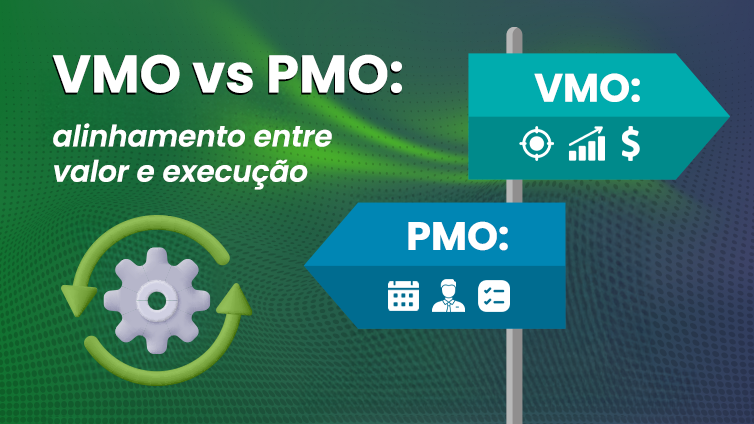
Understand the differences between VMO vs PMO, discover their strategic roles and know when to adopt each model or even combine the two.
The acronym may change, but the question remains the same: how to deliver results that really matter to business? That's where the discussion comes in. VMO vs PMO, two different management models, which often seem to compete, but in practice can complement each other.
Understanding what each one does and in what situations they shine is essential for those who want to implement project management without falling into fads or waste of resources.
01What is PMO and what is its traditional function in companies
Before detailing the performance fronts of PMO, remember: it is a structure created to bring order and alignment to projects. Next, you'll see how this happens in practice.
Governance, standardization and project control
The PMO, or Project Management Office, is an old acquaintance of companies. It emerged to organize the mess that poorly structured projects usually generate: burst deadlines, budgets without control and deliveries that do not meet the expected. Its main function is to create standards, define methodologies and ensure governance.
You want an example? Imagine several teams working on different projects, each with their own method. The result would be confusion and rework. The PMO enters precisely to unify this process.
Contribution of PMO to the implementation of the strategy
Despite the reputation of “controller”, PMO goes beyond reports and spreadsheets. It helps transform the company's strategy into reality, choosing which projects really make sense and ensuring that resources are well used.
A good PMO not only checks that the projects are within the deadline and budget. He also asks: Does this project still make sense? Does it contribute to strategic goals?
That's how the project management and its benefits cease to be only theory and begin to directly impact the results of the organization.
02What is VMO and why it has gained relevance
While PMO is usually associated with control and standardization, VMO comes up with a different proposal: to focus on the value delivered to the business. This change has a lot to do with the advancement of agile methodologies and the need to show rapid and relevant results.
Focus on value delivery instead of punctual deliveries
In the VMO (Value Management Office), the important thing is not only whether the project has ended in time or has cost it. The central question is, what did this delivery generate of real value?
This can mean increasing revenue, improving customer experience or accelerating innovation. The VMO is concerned with measuring impact, not just effort.
How VMO Connects with Agile and Strategic Culture
The VMO talks very well with the agile way of working. It privileges short delivery cycles, constant feedback and fast adaptation.
Another important point is strategic alignment. VMO acts almost as a translator: connects high management priorities with initiatives that really make sense to teams. Thus, decisions are no longer only operational and start to guide the future of the company based on tangible results.
03Difference between PMO and VMO: what changes in practice
So far you can see that PMO and VMO are not rivals, but they're not the same either. To better understand, it is worth looking at the points where they most differ in daily life.
Objectives, indicators and forms of action
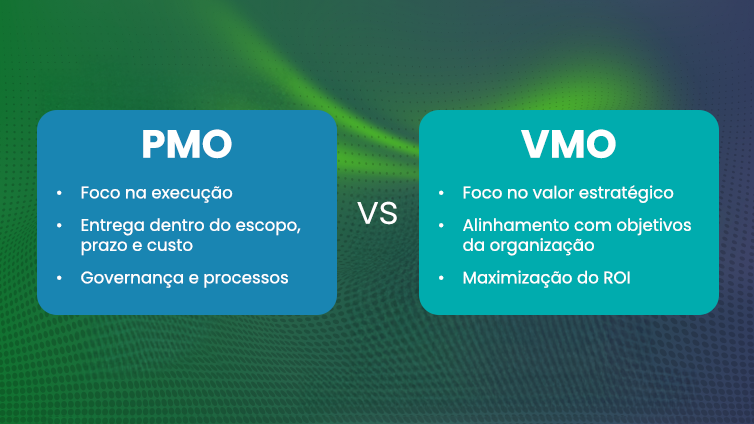
The PMO looks inside: well-defined processes, delivery within time and costs under control. Its indicators revolve around efficiency, such as spent hours, fulfilled milestones and reports delivered.
The VMO, on the other hand, has a more outward look. It measures whether the project has brought value to the business, such as increased revenue, reduced customer loss or improved customer satisfaction.
In practice, PMO can be involved in execution details, while VMO monitors the impact of choices made. One does not invalidate the other, but the papers are quite distinct.
Process-oriented approach vs. value-oriented approach
If PMO is the guardian of the lawsuits, VMO is the advocate of value. The first is concerned with maintaining order and standardization; the second is to ensure that each effort has strategic relevance.
That doesn't mean that lawsuits don't matter. Without them, any project will be improvised. But when the pressure is to deliver results that make a difference to the business, the VMO wins the lead.
This difference in mentality helps explain why so many companies have reviewed their way of structuring. While some prefer to keep the traditional PMO, others already migrate to the VMO or even combine the two models.
04When it makes sense to adopt a VMO, a PMO or both
Choosing between PMO and VMO is not a matter of fashion, but of context. Everything depends on the company's maturity in management, project profile and how prepared the organization is to embrace a more value-oriented vision.
Maturity analysis and management model
Companies in early stages of organization generally benefit more from a traditional PMO. After all, before thinking about measuring strategic value, it is necessary to guarantee the basics: well-structured projects, clear processes and consistent indicators.
In more mature organizations, which need to show rapid impact and align strategy with execution, VMO can be the natural path. It brings flexibility and focus on results perceived by the business.
Stages for organizational transformation
Migrating from a PMO to a VMO, or combining them, doesn't happen overnight. It is a transformation that requires leadership sponsorship, team training and clarity about which indicators really matter.
An important step is to identify which projects can be measured in terms of delivered value. Then create a culture where feedback and adaptation are part of the process. Only then can the organization balance discipline with agility.
05Count on MLPro to turn your PMO into a strategic advantage
In the debate VMO vs PMOThere is no single answer. Each model has its own space and can bring gains when used at the right time. Some companies need order. Others, of impact. A lot of both.
If the idea is to take a next step is to understand how these models can work in practice, the MLPro It might help. We are experts in portfolio management, programs and projects, and we already support hundreds of companies to align strategy and execution.
You want to see it in practice? Request a demonstration and how we can optimize management in your company.
Original content from the MLPro editorial library, fully preserved and translated for the English website.